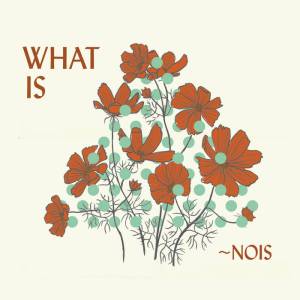
 An abundance of tildes occupies our title space as ~Nois returns with What Is ~Nois, the follow-up to Kinds of ~Nois. The playfulness of the album title translates to the music, while the implied question, “What is noise?” is a challenge to the listener.
What is noise? In music, the answer is subjective. Some listeners call rap, metal and improvised jazz noise, while others embrace these genres. In like fashion, some feel comfortable with the sounds of a city, while others call it cacophony. Is ~Nois noise? Even within the boundaries of What Is ~Nois, the variety of tracks may lead to differing opinions.
Even the question “What is ~Nois?” is difficult to answer. On the surface, the ensemble is an American saxophone quartet. But there are sometime more than four saxophones, while other instruments make happy appearances as well. Four composers bring four different approaches, leading us to propose that ~Nois is an experimental saxophone ensemble with a chamber music flair. To this listener, ~Nois is not noise, but noice – the exaggerated pronunciation of “nice” as a superlative.
None of this is apparent from the opening piece, Darian Donovan Thomas‘ “Sun Thrower.” In fact, this is exactly the sort of sublime music one might expect from a saxophone quartet, although on this track they are a saxophone quintet plus a keyboard. This track serves as the starting point for the conversation: the control group, as one might call it. Easing gently into the day, the piece casts sunbeams of sound, honoring its title, suggesting the first glimmers of light on the horizon. Phrases begin to accumulate and wrap around each other like young shoots. Percussion appears halfway through, transforming the piece into a dance track, another shift of the breeze.
So now we know what ~Nois is, right? Not at all, because the next piece, Aeryn Jade Santillan‘s “alternate endings.”, adds bass guitar, drums and vocals, a wild left turn. What we thought was modern composition is now rock, which pounces on the listener in a manner that may frighten the first time out, especially if one was relaxing to “Sun Thrower.” During the first half, one wonders if one is listening to BIG | BRAVE, but then the guitar collapses, the drums retract and Santillan falls silent to expose the saxophones. It’s rare to start a piece with its loudest moment, but it works; in fact, when one hears Francisco del Pino‘s guitar at the start of “Invisible,” one expects something like “Stairway to Heaven.” All bets are off. Again, the music defies expectation; the tone is calm in the first third, eventually tilting toward post-rock while creating a large brass space at its center that blooms in its finale.
Travis Laplante‘s triptych “Running in a Field of Flowers” completes the tonal arc, reflecting the feelings of spring, as well as the cover image. At first, the saxophones are walking, not running, but soon they will pick up the pace. The first movement serves as the introduction to the field, the wide open vista of multicolored spender. Nick Zoulek‘s alto saxophone takes center stage, leading the ensemble through tall grass, sending small animals scurrying, careful not to disturb the bees. This “Meditation” leads to “Descent,” a quieter, drone-like piece that to us ironically seems more like meditation; one can almost hear the breath of the ensemble and imagines them lying in the field. The pause gives way to “Searing Joy,” an intensely melodic movement widely chosen as a single, a succinct expression of the ensemble’s capabilities. No matter what genre they tackle, ~Nois exudes this searing joy. If this is noise, it’s a joyful noise. (Richard Allen)