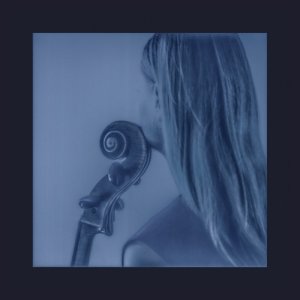
 Considering the new albums by Hey Elbow, Stephen Cordts, Rutger Zuydervelt, Steven Moore & Emil Amos and now Dobrawa Czocher, the color of the season is blue. State of Matter is the Polish cellist’s second LP, partially inspired by a move to the sea, but reflective of a state of mind: one that involves fragility, fluidity and flow. In the lead video for “Blue,” one sees the artist standing in a house whose walls are gradually revealed to be blue, looking out the window at the brightening blue sky, finally meeting the blue of the sea. In the final frame, she walks along the shore, blue cast upon blue.
Is this Czocher’s actual new house? We believe that it is, first filled only with creaks and steps, then with the sound of the sea. The ocean exists first pre-song, as a memory, but the waves appear when the music begins. And suddenly there are children, running through the forest and filling it with new life. The house is becoming a home, but so is family; so are the wider oceans around us. A fisherman casts a net; Czocher stares into the storm, her voice adding layers of wordless wonder.
The other lead single, “Phoenix,” follows, entering in a series of taps, the artist emerging from the landlocked life of Warsaw to the wide open possibilities of the Baltic Sea: not only a state of matter, but a state of mind. Czocher calls this “a symbolic moment of rising from the ashes, a moment of standing in one’s own power.” As the album contains two “Monologues” and one “Letter from the Soul,” we wonder if the piece should have appeared later in the set; but the thought of becoming a phoenix can keep one going, even if one has not yet arrived. “Letter” is particularly expressive, its swirling strings like intimations of melancholy, that other, internal blue. In contrast, the surges of “Sirens,” Czocher acting simultaneously as siren and sailor, exposes the dangers along the rocks.
The darkness of the closing “Goodbye” suggests that dark seas still lie ahead, but that the artist is prepared to sail into them. It’s up to the listener to interpret the final shade: soothing cerulean, mysterious midnight, serene sky. Where one hue ends, another begins. (Richard Allen)