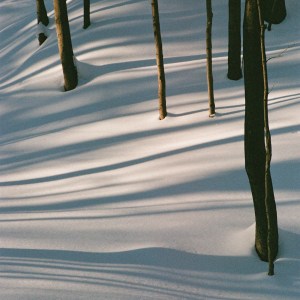
 Shortly after leaving her orchestral career behind to pursue a solo career, Isabel Pine had a startling revelation: in order to make her music sound warm, she’d have to move into the cold. Fables is recorded inside and outside “a small, remote cabin” in British Columbia, offering equal billing to the birds and the breeze. The cover art sings of light, shadow and cold, while the tracks speak to the solitude of winter and ultimately tilt toward the spring.
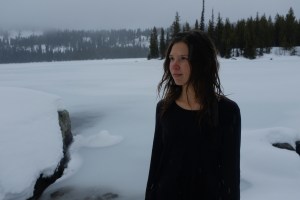
Pine’s meditations are played on violin, viola, cello and double bass,, undulating like snowbanks, content in their sonic curves. “Wolves” sounds forlorn at first, but the company of new instruments reinforces the solidarity of the pack. “Winnow” speaks of the sparseness of winter, referring not only to the process of separating wheat from chaff, but the movement of the wind itself. In her press photo, Pine seems content and at peace, surrounded by a simplicity that belies a greater depth.
 The short tracks operate as a suite, or a series of observances. The cold has a lot to teach if one is willing to listen, observe and embrace. “Wandering” may refer to both body and mind; Pine has found a new home, a place to prompt the imagination. The title track has a lighter feel than its neighbors, due partially to the higher register; in this composition, the winter is not something to be feared or endured, but embraced. In its wake, “West” attacks and then retreats, revealing the sound of Pine’s surroundings before “Snow” slows the tempo to a glacial pace.
“A Flickering Light” flips the script of “West,” beginning with pure field recordings, mirrored by Pine’s gentle strings. It’s unclear whether this light is flickering out or on; one’s very appreciation of winter hinges on the answer. Two other light-based pieces, “Sundog” and “Moonlight,” further the metaphor, while “Hollow” and “Bare” present a similar question: are these words lonely, or might they imply an ability to see further in a barren landscape? Given the overall tone of the album, one lands on the latter interpretation; Fables is the sound of an artist at home with her season, her surroundings and herself.
When one reaches the closing track, “Butterfly Lands on a Flower,” it is with the opposite feeling that one might expect. Instead of being happy that spring has arrived, one feels a bit of loss for the receding winter. Fortunately, in British Columbia, the season will come around sooner than it will for those further south; save for this year’s unusual “snow-scarce winter,” the territory can expect new flurries as soon as October. (Richard Allen)